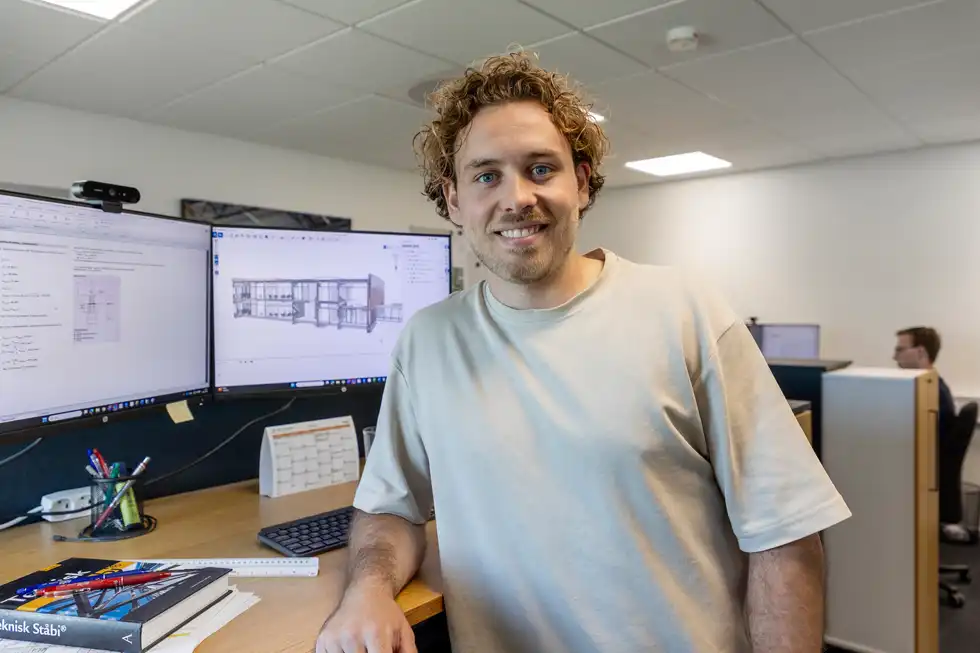
Asger Rosenfeldt Møller Jensen Is a Structural Engineer at DS Flexhal
At DS Flexhal, Asger Rosenfeldt Møller Jensen works with structural analysis and the calculations that help form the basis for safe, well-functioning structures. Meet Asger and read about his journey from intern to structural engineer, the professional collaboration in his daily work and the joy of seeing calculations and solutions take physical form.
Text: Cecilie Grønning Krieger
Constructing a building – whether it is an office, a multi-storey car park or a logistics centre – requires calculations, coordination and close collaboration between different disciplines. Everything must work together to ensure that the building remains safe, both now and in the future. This is part of everyday life for Asger Rosenfeldt Møller Jensen, who works as a structural engineer at DS Flexhal.
“Structural analysis is about whether a building can withstand vertical and horizontal forces – ensuring that it neither collapses nor topples over,” he explains.
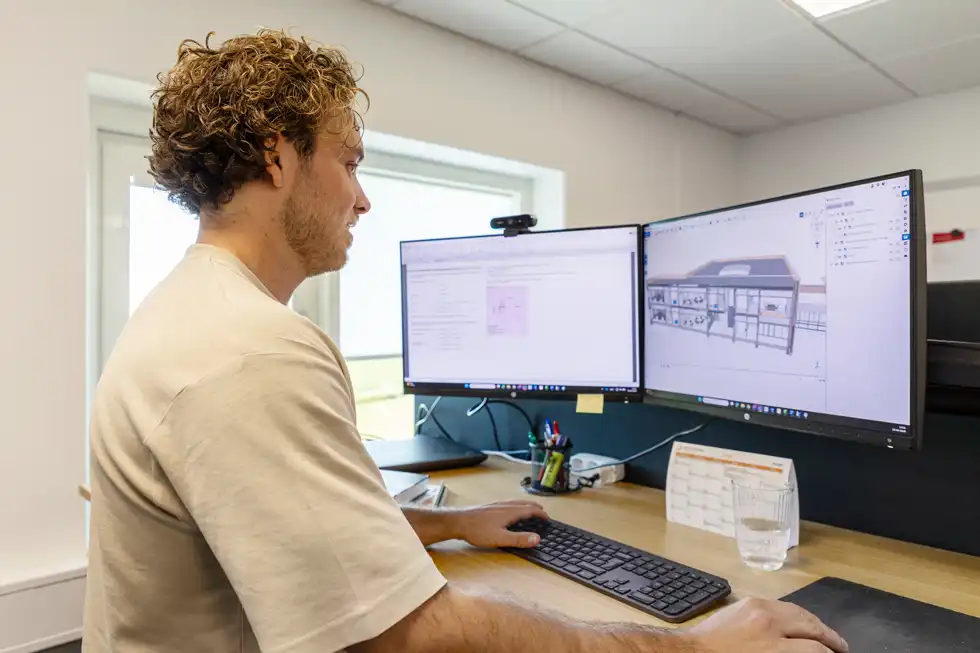
Asger works on the overall structural analysis of construction projects. Among other things, he calculates which elements are load-bearing and stabilising, which loads they must be able to withstand and how the structures should be assembled. The results are passed on to the steel and concrete design teams so that the individual components can be dimensioned and function as one complete structure.
From the Initial Calculations to the Completed Building
Asger’s and the structural engineering team’s working day changes as the project progresses. Early in the process, calculations, drawings and coordination with architects take up much of their time. Later, communication with project managers and the teams carrying out the work on site becomes a larger part of the job.
“It varies between performing calculations, discussing ideas, coordinating and resolving specific challenges. It involves a great deal of problem-solving,” says Asger.
Problem-solving is precisely one of the aspects he values most.
“Someone presents us with a problem, and then we get to work towards a solution. It is also motivating that the result becomes something physical. You can see the building you helped create and the value it provides.”
A Multi-Storey Car Park on Top of a Shop
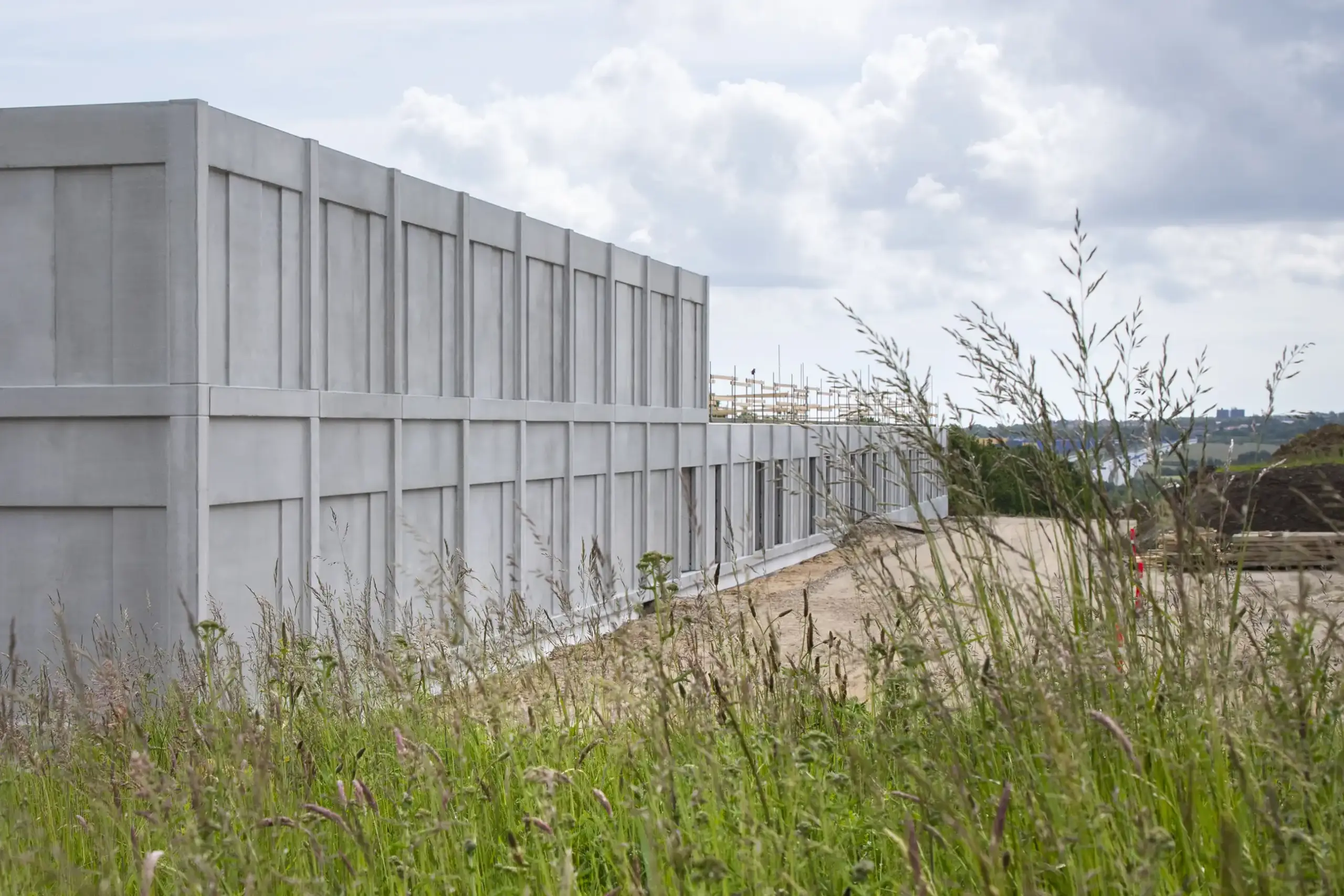
One of the first major projects for which Asger was responsible was Design City in Kolding. A multi-storey car park was constructed on top of a shop. Combining these different functions placed particular demands on the structure and on collaboration between the project’s various disciplines.
“It required a great deal of back-and-forth coordination to make all the components fit together. There is the weight of the cars, while parts of the structure are relatively lightweight. When wind affects the multi-storey car park, it places considerable demands on the wall elements to which the structure is secured,” Asger explains.
The project has since been completed.
“It has turned out really well. I am both pleased and proud to have contributed to it.”
Quality Assurance Is a Key Part of the Work
When Asger began working with structural analysis in practice, he was surprised by how much time was devoted to schedule management and quality assurance. Each calculation forms part of a larger context in which many disciplines depend on one another.
“You need to know how long the tasks will take and what must be in place before you can proceed. The project is a whole, and your own deliverables must fit into the overall schedule.”
“There is also a great deal of quality assurance. We check one another’s work, and major projects may also be subject to external review. I did not know that before entering the industry, but it is an important part of ensuring the quality of the completed building.”
From Intern to Permanently Employed Engineer
Asger joined DS Flexhal as an intern and later continued as a student assistant while completing his Bachelor’s and Master’s degrees in Engineering. He became a permanent employee in September 2024.
“The transition from intern to student assistant and later to permanent employee has been very natural because the working processes have essentially remained the same. As I have gained more experience, the scope and complexity of my tasks have increased.”
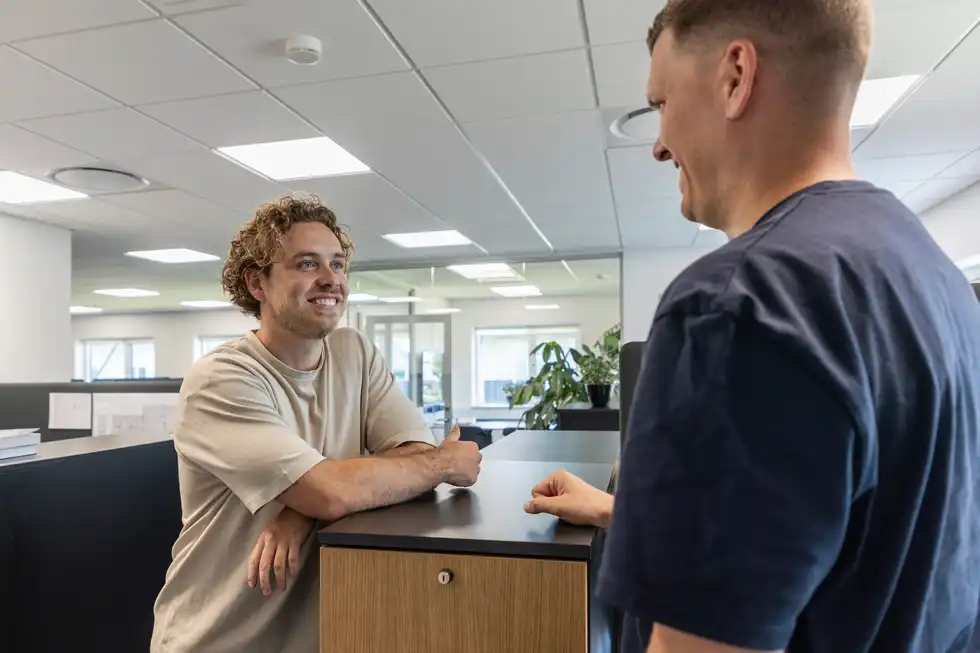
The opportunity to take responsibility and exchange ideas with colleagues is one of the main reasons why Asger has remained at DS Flexhal after completing his education.
“It is great to be able to pop into a colleague’s office, sketch a few lines on a piece of paper and continue working from there. Both the professional and personal exchange of ideas means a great deal.”
The same applies to collaboration across the company.
“The collaboration with estimating, sales, project managers and colleagues in structural engineering is really good. It is a great place to work, and the people are the main reason why I have stayed.”
For Asger, the next step is to continue his professional development within structural engineering.
“There is a lot happening within the company, and our department offers exciting development opportunities. I can easily imagine that I will still be here in five years’ time.”