

Articles
01 Sep 2026

Articles
Published
08 July 2024
Last Updated
16 September 2026
15 min read
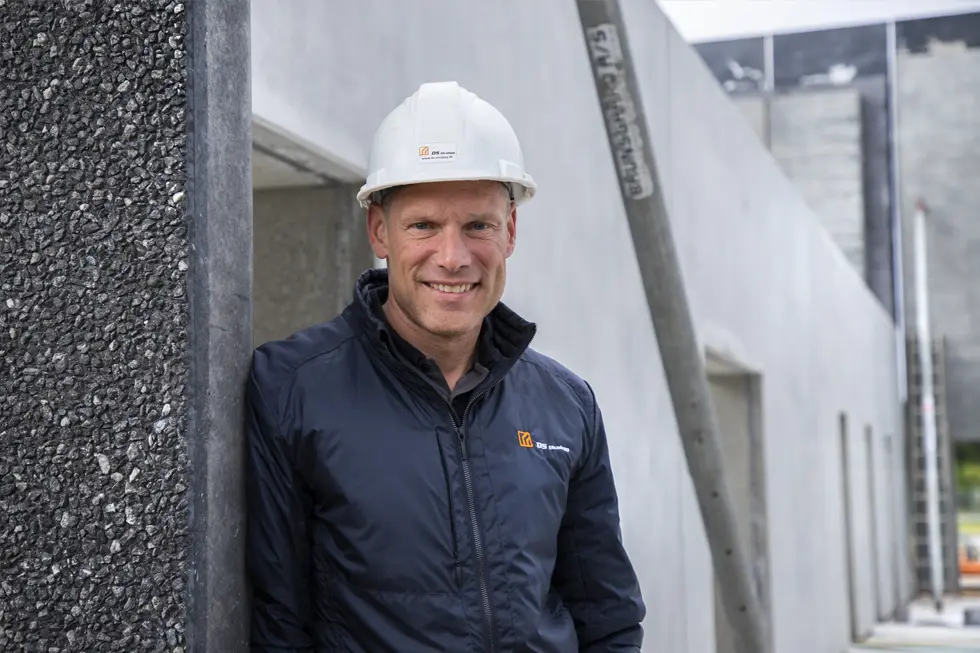
EKKO has met one of DS Gruppens ‘concrete men’ – Flemming Hvidberg Madsen from DS Elcobyg, for whom avoiding unnecessary overconsumption of resources in the construction industry is a cause close to his heart.
Flemming Hvidberg Madsen is a market manager and salesperson at DS Elcobyg, but he does not sell at any cost. He wants to be a trusted adviser who also assesses projects with careful consideration for resources and gives customers honest recommendations on building responsibly.
Flemming is part of the DS Group’s interdisciplinary sustainability group and also has a seat at the table in the ‘Sustainable Concrete Initiative’ under the Danish Concrete industry association.
Flemming is passionate about optimising resources, and he does his part to influence the direction the industry has taken towards excessive material consumption.
Hearing Flemming’s story brings to mind the title of an old revue song – ‘That’s Not How It Was in the ’90s’…
When Flemming, having graduated as an engineer in 1996, had to calculate the specifications for a concrete floor slab in a multi-storey building, the standard was 18 cm, whereas today a thickness of 22 cm is required. Flemming emphasises that the buildings from the ’90s are still standing. He explains that robustness requirements are much stricter today: structures are tied together more extensively, and greater quantities of reinforcement, pipes and wall screws are used. This results in significantly higher material consumption, which Flemming believes makes no sense.
“Stop for a moment, call 112 or get an adult involved… We need to use common sense – what we did in the ’90s still holds up!”
– Flemming Hvidberg Madsen
“I can be a little provocative by saying that it is not because the 18 cm is no longer sufficient. If, for example, you take the whole city of Aarhus, it ought not to be ‘standing’ – it simply could not be approved under the new standards. And what I am saying is: that cannot be right – today we have programs that can calculate right up to the limit, and then the new standards say that what I calculated a few years ago cannot hold up today – it is not because we have become heavier, or because we calculate using a different wind load. No, it is because we add safety upon safety upon safety,” Flemming explains – and he continues:
“Today, for example, we have to take account of impact noise through the floors and natural frequency. In other words, we have added extra ‘luxury features’ to buildings so that you cannot hear your upstairs neighbour or feel a floor flexing if you jump up and down. Well, that may be inconvenient, but are we willing to pay extra in terms of our CO2 footprint? I can honestly say that it is not necessary for the durability of the building, so is it really worth it?… After all, it is not the optional extras that make a car run,” Flemming jokes.
“We must remember that the Earth has existed for billions of years, and that it is only within the past 250 years that we have destroyed it – that is bloody well not fair! We need to think circularly – what we consume, we must replenish. It is a cause we must fight for!”
– Flemming Hvidberg Madsen.

“Today, we produce concrete with a higher strength than necessary – partly because of the 28-day rule. After 28 maturity days, we must declare that the concrete has reached 95% of its strength.”
And here, Flemming paints a clear picture for laypeople:
”If you need to bake a loaf of bread that must be ready today, you need considerably more yeast than if you make a slow-rise loaf – the same applies to concrete: the longer it is allowed to ‘rise’, the stronger it becomes. So, if we moved away from the 28-day standard, we could use considerably less cement (= yeast) without compromising the quality of the final product. A newly cast concrete element only really needs to be strong enough to be removed from the mould; after that, a long time passes before its strength is put to use. If, for example, it were assessed after 50 days, cement consumption could be minimised.”
”The new standards also require us to calculate and document impact loads. In other words, we must take into account the possibility of a lorry hurtling directly into a building.
– Flemming Hvidberg Madsen
”When I am calculating a project, I would venture to say that, without compromising actual safety, I can reduce material consumption by a third. However, this requires a willingness to amend the standard, including consequence classes, and to compromise on the serviceability limit state.”
”The new standards also require us to calculate and document impact loads. In other words, we must take into account the possibility of a lorry hurtling directly into a building, and the dimensions must be sufficient to prevent collapse. Even though it may be a one-in-a-million occurrence, we must design walls with this factor in mind. Are we willing to pay such a high CO2 price for that? Should we not actually weigh the risk of a lorry collision against the risk of ‘climate bankruptcy’? Which is more likely? And if climate change sweeps across the land, nothing will withstand it anyway!”
Flemming points out that even with all the oversizing factors, errors will still occur – for example, a bricklayer may have forgotten to secure a gable, or there may be a construction error on site – the building would still collapse, regardless of how many materials we put into a construction project.
“The October storm that we have just experienced came from the east at a speed of 26 m/s; the standard requires buildings to be able to withstand 24 m/s, and it should also be remembered that wind loads are normally calculated on the basis of westerly winds. To my knowledge, not a single building was blown down – some gables or roof tiles may have been damaged, but that is due to workmanship errors, and that type of Error40 will still occur.”
When speaking with Flemming, you can really sense how passionate he is about the issue – he can keep giving examples of the excessive use of materials.
“My conclusion is simply that reinforcement is increased, thicknesses are increased and materials are overused, yet it is not as though the client gets a better building – it merely becomes more expensive and generates more CO2.”
– Flemming Hvidberg Madsen
“Safety is a good thing, but in Denmark we take a belt-and-braces approach – if, for example, you compare a fire in Denmark with a fire in Germany, the fire is apparently ‘more dangerous’ in Denmark, judging by the requirements we impose in this country. For example, if you are building a multi-storey car park in Denmark, you have to use more materials than you would for the same structure in Germany.”
“The rules are less stringent in our neighbouring countries. For example, Jonas Bang Eriksen from DS Flexhal’s parking division has helped carry out calculations showing that approximately 25% more steel is used in the load-bearing elements of a multi-storey car park in Denmark than in Germany – once again, you have to ask yourself ‘WHY’ – it simply makes no sense. In Sweden, warehouses of up to 50,000 m2 can be built without fire compartments, whereas in Denmark a building may be no larger than 10,000 m2 – WHY?”
“My conclusion is simply that we are increasing the reinforcement, increasing the thicknesses and overusing materials, and it is not as though the client gets a better building – it simply becomes more expensive and produces more CO2.”
Flemming cites an example of two comparable projects in Kolding, one built by DS Elcobyg and the other by a competitor. The buildings were virtually identical but were constructed under the old and new standards respectively. The difference in price between the two construction projects was almost one million Danish kroner.
“You can look at some old projects and think, ‘Hang on, was that really possible?’ For example, when we had to renovate our old loading bay, the existing walls had only a few thin reinforcing bars – when we recalculated the project, the amount of reinforcement required to demonstrate compliance was completely absurd.”
At the risk of repeating myself, we are using more and more raw materials in our buildings, but honestly, if you knew that the materials were becoming thicker and thicker so that an upstairs neighbour could walk around without you hearing them, would you be willing to increase material consumption by approximately 25% – is it really worth it? If we go back just five years, as a sales manager I might have thought that I could add more material and thereby make more money, but today it leaves a bad taste in my mouth. At DS Elcobyg, for example, we have acquired a mesh-welding machine, we have virtually no waste, and we have optimised production – but our efforts are being completely undermined by oversizing in the form of unnecessary additional reinforcement. That is what I want to bring to the debate. Enough is enough; we need to be more responsible, so step up and take action! We must use our resources properly.”
“There is a tendency to publicly vilify the responsible structural engineers, who are blamed for being overly cautious, resulting in the excessive use of resources. As a professional and a developer, you may think, ‘I am prepared to stand by that’, but you have to ask yourself whether you would be willing to ‘go to prison’ for approving something that is structurally sound but contravenes current regulations. Stop attacking the structural engineers – they are held personally liable for approving a building that does not comply with the standards. I have great respect for ‘the authorities’; this is not where the changes need to come from. As an industry, we must stand together and assume collective responsibility. The standards/SBI committees should also take sustainability into account when introducing new requirements. Remember that the certification bodies merely have to ensure that the standards are complied with. However, I am pleased that the issue has been placed on the agenda; only by debating and highlighting the problem can we raise awareness of the need for sustainable construction rather than design-driven overconsumption of resources,” says Flemming.
“If we imagine that DS Elcobyg invented a new, less resource-intensive product, it would be virtually impossible to sell because no consulting engineers would dare accept responsibility for using it without documentation.”
“I believe we should establish a fund that can provide financial assistance in compensation cases where a new product has been developed and necessarily has to be tested in real-world conditions. It must, of course, have been developed in good faith and without malicious intent. There is currently a great deal of discussion about reusing concrete, but no one really dares to accept responsibility for it because it is virtually impossible to separate again. Today, concrete is crushed and reused for roads, but if it could instead be reused in new structures, its service life would be extended even further.”
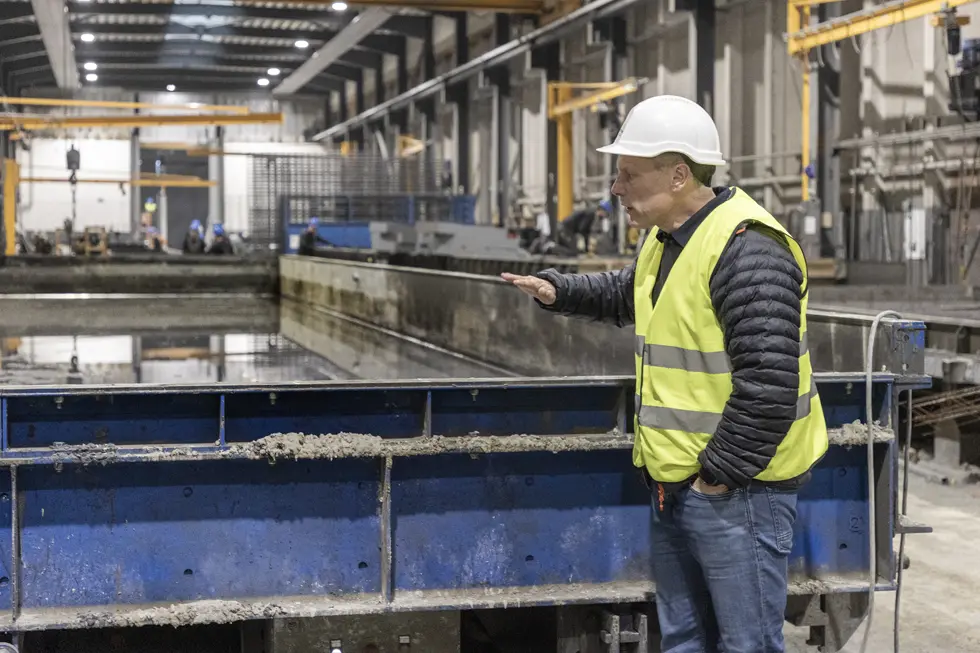
Flemming ‘sings’ as well as he can to inspire action.
‘I may be exaggerating slightly to make the point, but stop for a moment, call 112 or get an adult involved… We need to use common sense – what we did in the 1990s still works!’
In 15 to 20 years, we probably will not have much sand left in Denmark – today, we use the materials we have, and we use them incorrectly. I am part of that, and it saddens me that we are using our resources incorrectly. I am saddened that we are misusing our materials – in the past, we thought our resources were inexhaustible, but now we can see that we cannot carry on – we need to move away from that way of thinking. We need to use our common sense – to ask ourselves whether it makes sense. A good question is: ‘What did I do 20 years ago, and why do I do it this way today? More and more things have simply been added that are not necessary,’ Flemming observes.
‘We need to remember that the Earth has existed for billions of years, and that we have destroyed it within the past 250 years – that’s bloody unfair! We need to think circularly – what we consume, we must restore. It is a cause we must fight for!’ concludes Flemming Hvidberg Madsen.
And now, back to the revue song, which admittedly refers to the 1890s – amusingly, its opening line goes: ‘The youth of today are full of nonsense and frivolity; being old-fashioned ought to be fashionable now’…
Without suggesting, incidentally, that Flemming rejects progress and innovation, in this context it seems to express his view that the construction industry – in terms of resource consumption – ought to take a step back and avoid the ‘new-fangled’ overconsumption of resources.

About the Author
With her solid experience as both a graphic designer and art director, Fie sets the visual direction for communication across the companies in DS Gruppen. With a sharp eye for design, she ensures that the visuals support the message and capture attention. Fie also brings many years of experience as both a writer and photographer, including from her time working in publishing and running her own advertising agency. Her background also includes extensive experience with visual communication for both B2B and B2C audiences.
Articles
01 Sep 2026

Articles
06 Aug 2026

Articles
13 Jun 2026
Articles
12 Jun 2026
Articles
11 Jun 2026